
Appearance
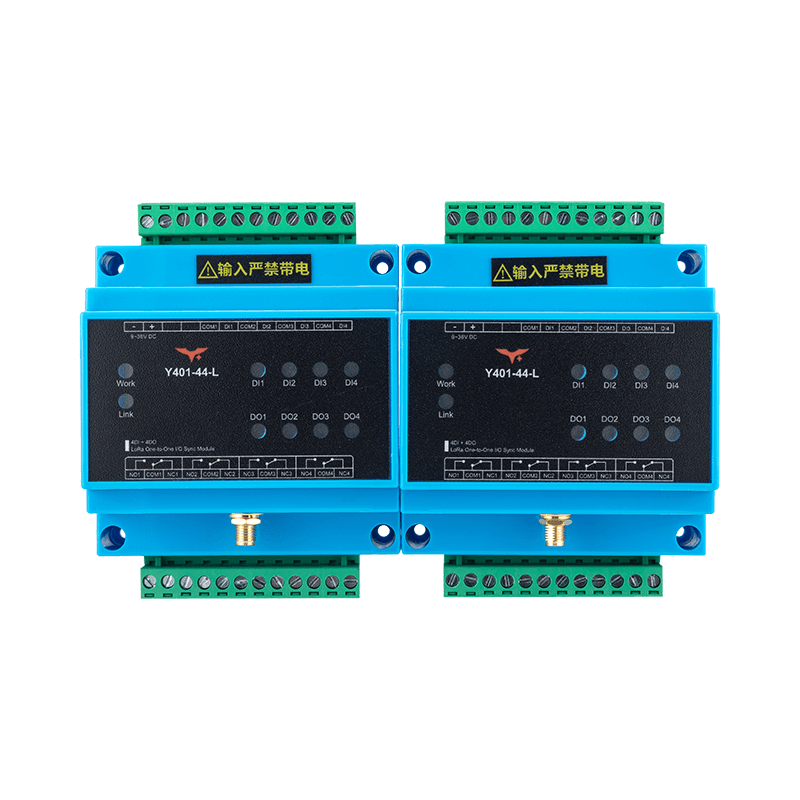
Y401-44-L LoRa Wireless I/O Module Datasheet
| Y401-44-L |
|---|
 |
Contents
- Overview
- Ordering Information
- Key Features
- Technical Specifications
- Interfaces and Indicators
- Mechanical and Environmental
- Installation and Wiring
- Important Notes
1. Overview
The Y401-44-L is a four-channel point-to-point wireless I/O terminal based on LoRa modulation. Two units (Device A and Device B) are factory paired. All four channels operate independently and are ready to use without additional setup.
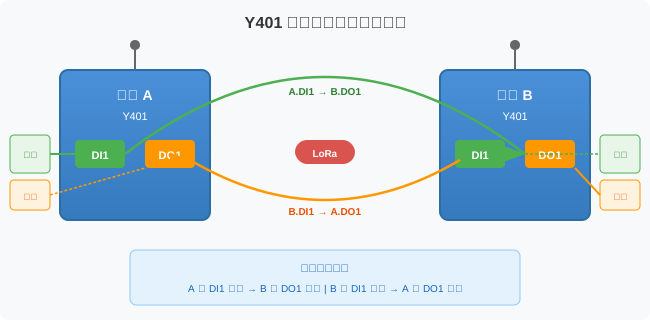
Operating Logic
- Device A
DIclosed -> the correspondingDOon Device B energizes - Device A
DIopen -> the correspondingDOon Device B resets - Bidirectional operation: the same logic applies from Device B to Device A
Channel Mapping
| Device A | Device B |
|---|---|
| Channel 1 input | Channel 1 output |
| Channel 2 input | Channel 2 output |
| Channel 3 input | Channel 3 output |
| Channel 4 input | Channel 4 output |
Typical Applications
Multi-channel remote control, pump interlock, industrial equipment control, and alarm systems
2. Ordering Information
Model Naming
text
Y401-44-L
  |   |  `-- L: LoRa wireless communication
  |   `----- 44: 4DI/4DO configuration
  `--------- Y401: point-to-point wireless I/O module series
Package Contents
| Qty. | Item |
|---|---|
| 2 | Y401-44-L modules (Device A and Device B) |
| 2 | 470 MHz magnetic-mount antennas |
| 2 | DIN rail clips |
| 1 | Quick reference guide |
| 1 | Warranty card |
3. Key Features
- Four-channel control - Four independent channels with no cross-interference
- Long-range communication - Up to 5000 m in open area
- Plug-and-play deployment - Factory paired, no configuration required
- Wide supply range - 9 to 36V DC with reverse-polarity protection
- Relay output - 4 x SPDT relays, rated at AC 277V 5A / DC 28V 5A
- Universal DI - Supports dry contact and NPN inputs
- Status indication - LEDs for power, link, input, and output status
- Industrial design - Hardware watchdog and 35 mm DIN rail mounting
- No operating fee - No SIM card and no subscription required
4. Technical Specifications
Wireless
| Parameter | Specification |
|---|---|
| Frequency band | 398 to 525 MHz |
| Communication range | 5000 m (open area) |
| Antenna connector | SMA |
| Standard antenna | 470 MHz magnetic-mount antenna |
Electrical
| Parameter | Specification |
|---|---|
| Supply voltage | 9 to 36V DC |
| Max. power consumption | 2W |
| Input channels | 4 x NPN signal / dry contact |
| Output channels | 4 x SPDT relay |
| Output rating | AC 277V 5A / DC 28V 5A |
| Operating temperature | -20 to +85 degC |
| Operating humidity | 10% to 90% RH, non-condensing |
5. Interfaces and Indicators
Interface Summary
| Interface | Description |
|---|---|
| Antenna | SMA connector for LoRa antenna |
| Power | DC 9 to 36V input with reverse-polarity protection |
| Input | 4 x passive switch input (DI + COM) |
| Output | 4 x relay output (NO + COM + NC) |
LED Indicators
| LED | Function | Status |
|---|---|---|
| Power | System status | On after power-up |
| Link | Link status | On when the wireless link is established |
| Input 1 to 4 | Input status | On when the corresponding DI is closed |
| Output 1 to 4 | Output status | On when the corresponding relay is energized |
6. Mechanical and Environmental
Mechanical Specifications
| Parameter | Specification |
|---|---|
| Dimensions | 88 x 72 x 59 mm |
| Weight | Approx. 50 g |
| Mounting | 35 mm DIN rail |
| Protection rating | IP20 |
| Housing material | Flame-retardant plastic |
7. Installation and Wiring
Input Wiring
Mechanical switches (maintained switch, float switch, relay contact):
- Connect directly between
DIandCOM - No external power supply is required
NPN signal:
- Emitter ->
COM - Collector ->
DI - Do not connect an external voltage source to the input terminal
Output Wiring
Direct load (<= 1 kW resistive load):
- Wire the load in series with the relay output
High-power load (> 1 kW):
- Use an AC contactor or external power relay
Installation Notes
- Install the antenna vertically in an open area, about 2 m above ground.
- Keep the unit away from large metal structures.
- Tighten the antenna connector securely.
- Mount the unit inside the control cabinet on a 35 mm DIN rail.
- Leave enough space for ventilation.
8. Important Notes
- Communication mode - Half-duplex communication, not intended for hard real-time control.
- Frequency range - Recommended operating range is 398 to 525 MHz. Performance may degrade outside this range.
- Antenna placement - Install the antenna vertically in an open area and keep it away from metal obstructions.
- Channel isolation - The four channels operate independently without mutual interference.
- Manufacturer: Hunan YenGear Tech Co., Ltd.
- Address: Room 21014, Building 1, Fudi Xingguang Tiandi, Yingxin Road, Yuhua District, Changsha, Hunan, China
- Email: hi@yengear.com
- Website: www.yengear.com